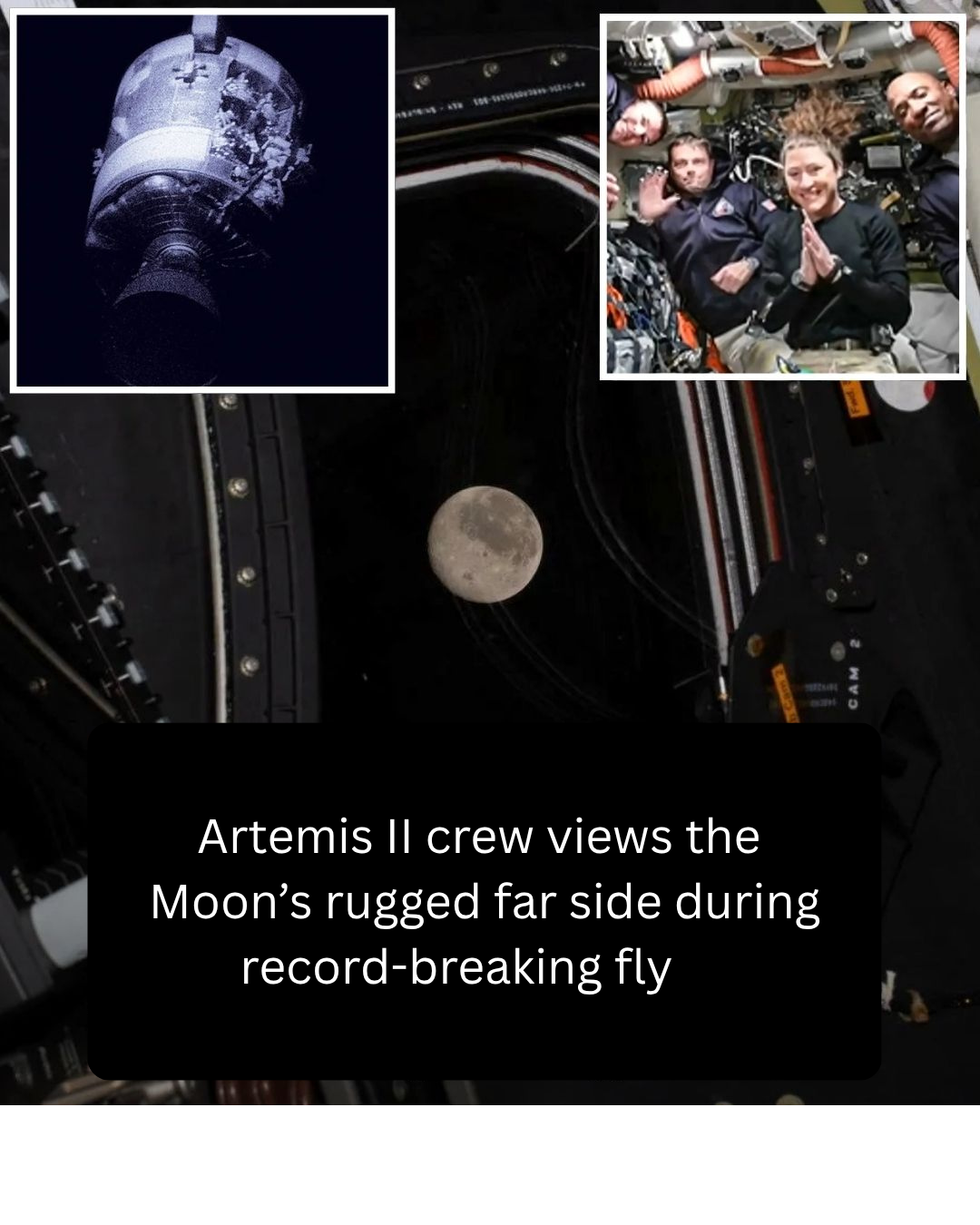
Artemis II Breaks 56-Year Distance Record, Voyages Farther From Earth Than Any Humans Ever
Artemis II has sent humans farther from Earth than anyone in history, surpassing a record held since the Apollo era. On Monday the four-person crew passed Apollo 13’s long-standing mark of 248,655 miles, and later that evening reached about 252,756 miles from Earth as their capsule sped past the far side of the Moon at nearly 2,000 mph. After the milestone, the spacecraft began its return trip toward a planned Pacific splashdown.

A view of the moon from the Artemis II’s Orion Capsule.NASA
The new distance record came almost 56 years after Apollo 13 set the previous benchmark on April 14, 1970, when that mission used a lunar gravity assist to loop back toward Earth after an onboard emergency. Artemis II likewise used the Moon’s gravity to slingshot home, relying on momentum and only small course adjustments.
During the flyby, the crew experienced a scheduled communications blackout while the Moon blocked signals; contact was reestablished after the blackout ended. The astronauts spent the pass observing terrain on the Moon’s far side — seeing regions that were largely hidden from prior Apollo crews because of mission timing and lighting.
From the capsule windows the far side appeared surprisingly rugged and colorful, with shades of brown and green and bright white patches inside some craters. Crew members described the landscape as otherworldly — “impossibly rugged” and studded with bright pinpricks that stood out against the dark plains.
Artemis II will spend the next several days returning to Earth. The capsule is expected to exit the Moon’s influence and fall back under Earth’s gravity before splashing down in the Pacific near San Francisco late Friday, if all goes to plan.
Looking ahead, NASA plans to continue the Artemis program with Artemis III and IV aiming to return humans to the lunar surface later this decade, marking the first crewed moon landings since 1972.