He was the most famous man in the world — and he walked away from it all for a little girl who called him Papa
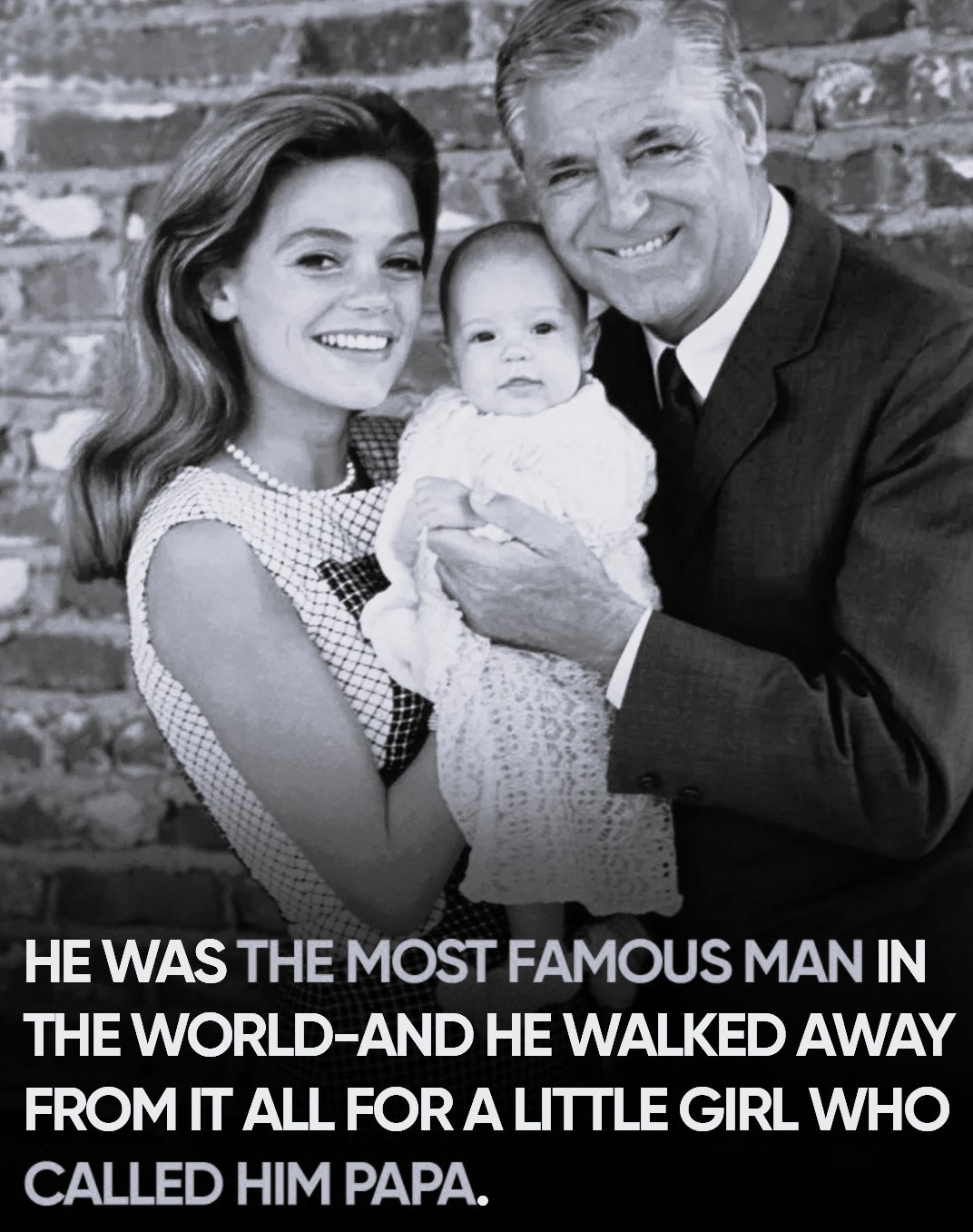
He was the most famous man in the world — and he walked away from it all for a little girl who called him Papa.
1966. Cary Grant was 62 years old and at the absolute peak of his powers. Not fading. Not struggling to get roles. Peaking.
He was the man every woman wanted and every man wanted to be. Handsome, sophisticated, wealthy beyond measure. He had starred opposite Grace Kelly, Katharine Hepburn, Audrey Hepburn. He had worked with Alfred Hitchcock on some of cinema’s greatest films. His name on a movie poster guaranteed success.
Studios were offering him fortunes. Producers were literally knocking on his door. His agent was begging him to sign contracts. The world wanted more Cary Grant.
And then, on February 26, 1966, a baby girl was born.
Her name was Jennifer.
And Cary Grant made a decision that shocked Hollywood to its core.
He quit.
Not a break. Not a sabbatical. Not “I’ll do one film a year.” He walked away completely. At 62, when most actors are desperately clinging to relevance, Cary Grant — still bankable, still beautiful, still brilliant — simply stopped.
Hollywood couldn’t comprehend it. Reporters pressed him for explanations. How could he abandon his throne? Why would he walk away from guaranteed success?
Grant’s answer was simple: “I’ve had my time in the limelight. Now I want to watch my daughter grow up.”
He meant it literally.
The man who had taken direction from Alfred Hitchcock started taking direction from a toddler. Red carpets became breakfast tables. Movie premieres became school drop-offs. Sound stages became playgrounds.
He didn’t hire people to raise Jennifer while he maintained his career. He didn’t do “special appearances” to stay relevant. He didn’t keep one foot in Hollywood while pretending to be present at home.
He actually, completely, walked away.
Friends noticed the transformation immediately. The guarded, private movie star became open and joyful. The man who had always seemed slightly untouchable became absurdly silly.
He showed up at parent-teacher conferences. Not as Cary Grant, movie legend. As Jennifer’s dad. He packed her lunches with funny notes tucked inside. He spent hours teaching her about the world — not the glamorous world of cinema, but the real world of curiosity and wonder.
He became the father he’d never had. His own childhood had been difficult — his mother institutionalized when he was young, his father distant. He’d spent his life performing, hiding behind the persona of “Cary Grant,” a character he’d created from a working-class British boy named Archibald Leach.
With Jennifer, he could finally just be himself.
“She made me a better man,” he told a friend.
For twenty years, while Hollywood moved on without him, Cary Grant lived a life that had nothing to do with fame. He didn’t give interviews reminiscing about the glory days. He didn’t write a memoir. He didn’t appear at awards shows to thunderous applause.
He just raised his daughter.
Years later, Jennifer Grant wrote about her childhood in her memoir, Good Stuff: A Reminiscence of My Father, Cary Grant.
She didn’t describe a distant icon who occasionally showed up between film shoots. She described “Papa” — a man who was present, engaged, and devoted. A man who made her feel like the most important person in the world.
“He wasn’t Cary Grant to me,” she wrote. “He was just my Papa.”
Think about what he gave up for that. Not just money — though he walked away from millions. Not just fame — though he was worshipped by millions. He gave up immortality.
If he’d kept making films through the 1970s and 1980s, he would have added decades to his legend. He could have transitioned to character roles, won an Oscar, cemented his status even further.
Instead, he chose twenty years of moments no camera would ever capture. Bedtime stories. Scraped knees. School plays. Quiet mornings. Ordinary magic.
On November 29, 1986, Cary Grant died suddenly of a stroke. He was 82 years old.
Jennifer was 20.
While the world mourned a movie legend, she mourned something infinitely more precious: the man who had chosen her over everything else.
He didn’t leave her wealth (though he did). He didn’t leave her a famous name (though he did). He left her with absolute certainty that she had been loved completely. That she had mattered more to him than applause, more than acclaim, more than the adoration of millions.
Most people will never know what it’s like to be Cary Grant — to be that famous, that successful, that desired.
But every parent faces the same choice he did, in smaller ways, every single day.
Do you choose the career opportunity or the school play? The business trip or the bedtime story? The impressive achievement the world will see or the quiet moment only your child will remember?
Cary Grant had more to lose than almost anyone. And he chose the moments only one little girl would remember.
Fame fades. Wealth disappears. Applause echoes and dies.
But the impact of a parent’s presence lasts forever.
Cary Grant proved that the most important role any of us will ever play isn’t the one the world sees. It’s the one we play within the four walls of home, for the audience of the people who call us Papa, or Mama, or Dad, or Mom.
He was Cary Grant — one of the most famous men who ever lived.
But his greatest role was the one no camera ever captured.
The one where a little girl looked up at him and saw, not a movie star, but her whole world.